See it before you install.
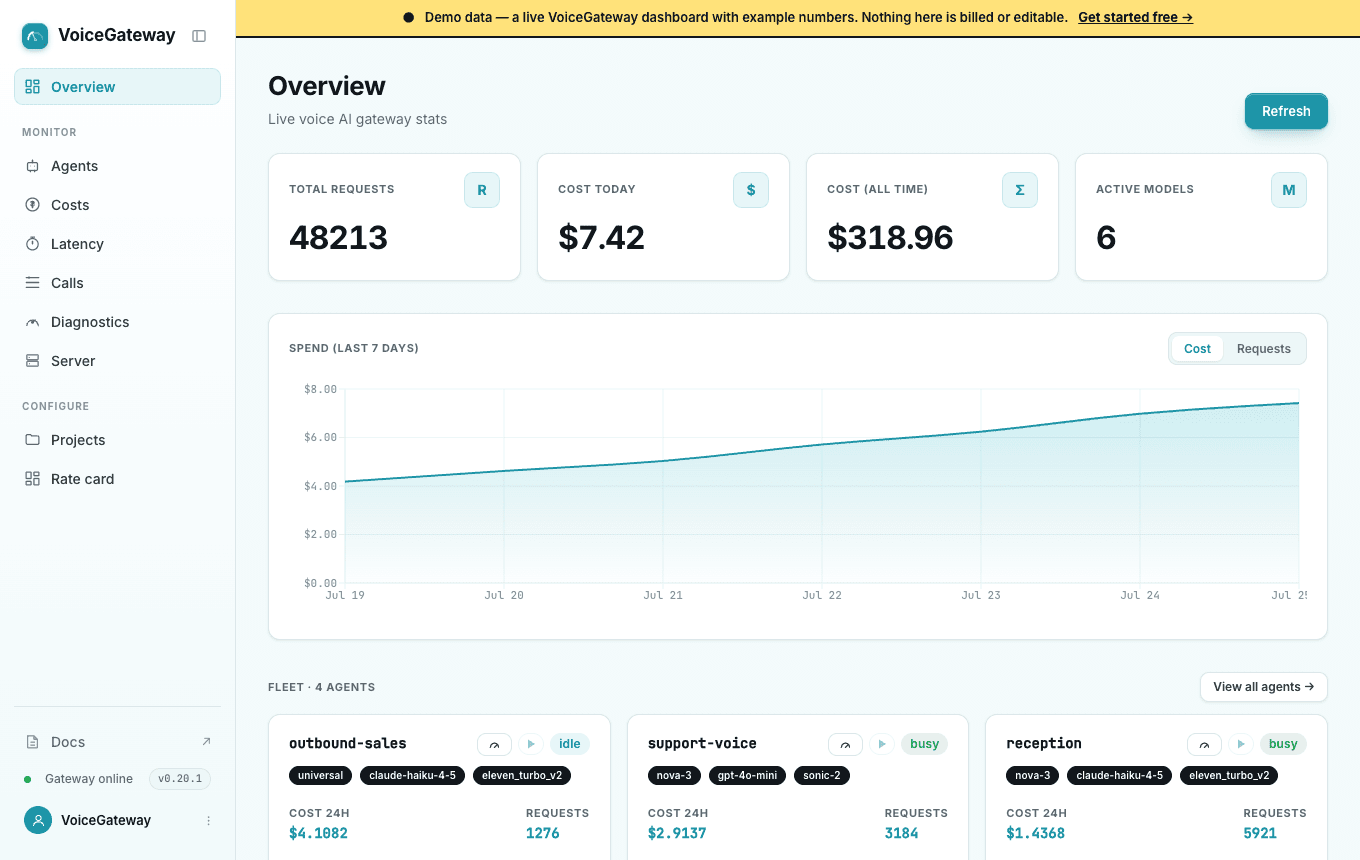
A real VoiceGateway dashboard on example data: per-agent cost, the STT/LLM/TTS latency split, fleet compute and memory, reconciliation. No signup, nothing to run.
Two lines. Every call priced.
attach() meters the STT, LLM, and TTS instances you already run on LiveKit or Pipecat. It reads cost and timing off each call and never sits in the audio path.
from voicegateway import attach

# your existing LiveKit / Pipecat session, on your own keys
attach(session) # every STT, LLM, and TTS call now priced and timedEvery dollar and millisecond, on the record.
VoiceGateway records one telemetry row per request and rolls it up into the views your team already reaches for: spend, latency, calls, and reconciliation.
Cost tracking & reconciliation
Every STT, LLM, and TTS call priced through a single catalog. Spend by pipeline stage, provider, and model, then run voicegw reconcile to verify recorded numbers against provider invoices.
Latency waterfalls
Per-stage latency with time-to-first-audio, TTFB, and p95. Compare distributed against colocated deployments to see where the milliseconds go.
Call records
One record per telephony or web call, expandable into a per-request latency timeline across every STT, LLM, and TTS hop.
Agent dashboard
Live worker cards showing each STT/LLM/TTS stack, per-project spend and latency, and a real test call you can place from the dashboard.
Diagnostics
Built-in LiveKit credential and connectivity checks, so a broken key surfaces here before it ever reaches a caller.
Open source + hosted
An MIT-licensed engine you can self-host, or the hosted cloud dashboard when you would rather not run it yourself.
Replay any call, priced to the token.
A per-request cost row and a stage-by-stage latency waterfall, reconciled against the invoice you actually pay.
- Priced per request, split across STT, LLM, and TTS
- Time-to-first-audio and p95 for every stage
- Recorded totals checked against provider invoices
Every provider you run, on one meter.
attach() meters whatever STT, LLM, and TTS plugins you already run on LiveKit or Pipecat. It never picks your providers. The common ones are priced out of the box; anything else records and flags for a rate-card entry.
Three env vars. First call lands in seconds.
Keep your agent on its own provider keys. Set a collector URL, an ingest key, and a project name, and the first telemetry row appears within moments. No pipeline changes.
- 1
Create a project and ingest key
Spin up a workspace in the dashboard and mint a
vk_ingest key scoped to it. - 2
Set three environment variables
VOICEGW_COLLECTOR_URL,VOICEGW_API_KEY, andVOICEGW_PROJECT.attach()reads them. No changes to your pipeline. - 3
Place a call
Telemetry streams in as the call runs. Cost rows, latency, and reconciliation populate within moments.